
Dr. Moballeghi: The Scientific Institutions of the Islamic World Need a Kind of "Theological Philosophy" to Reproduce Islamic Unity
Dr. Moballeghi: The Scientific Institutions of the Islamic World Need a Kind of "Theological Philosophy" to Reproduce Islamic Unity
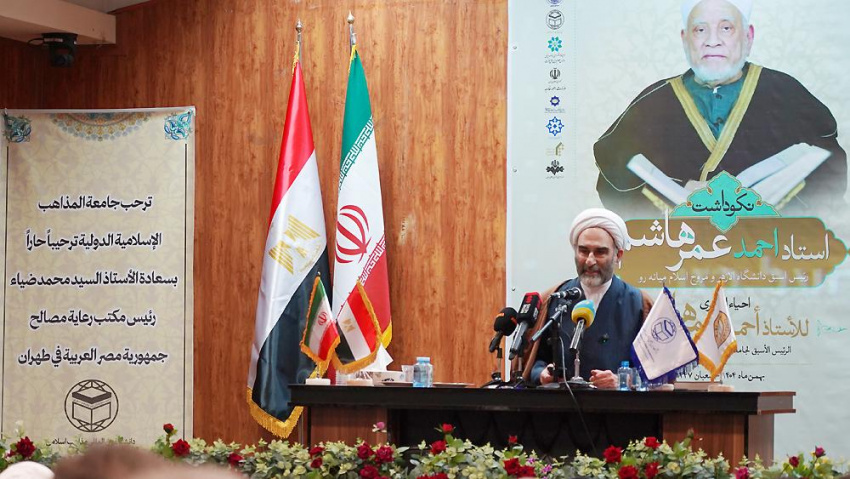
Ayatollah Ahmad Moballeghi, during his speech at the memorial ceremony of the late Professor Dr. Ahmed Omar Hashim, former President of Al-Azhar University, held at the International University of Islamic Denominations, referred to the historical position of Al-Azhar in the field of Islamic unity and stated: Al-Azhar has passed one of its brightest stages in history by establishing the "Dar al-Taqreeb Bayn al-Madhahib al-Islamiyyah," an institution that created profound and inspiring transformations in the Islamic world and paved the way for the formation of the Islamic Denominations Union.
He added: The Dar al-Taqreeb experience showed that accepting the ijtihad of various denominations and recognizing the followers of each denomination could help heal the historical wounds of the Islamic Ummah and achieve religious coexistence; a path that has also been followed in the Islamic Republic of Iran based on the principles of the Islamic Revolution and the unifying thoughts of Imam Khomeini (RA).
A member of the Assembly of Experts raised the question: What role does Al-Azhar play today in the path of unity? He emphasized: While recommending ethical, jurisprudential, and social tolerance is necessary, it is not sufficient to achieve Islamic unity, as the most powerful knowledge in creating unity is the science of theology (Ilm al-Kalam).
Dr. Moballeghi criticized past approaches in the field of unity, saying: In the past, it was believed that focusing on theology, due to its focus on the specific beliefs of various denominations, could activate historical biases. Therefore, Kalam was set aside, and only commonalities or ethical recommendations were emphasized, while the only science that can explain the ontological foundations of the Islamic Ummah is theology.
He stressed the necessity of a "philosophical return to theology" and added: Without theology, Islamic unity cannot be achieved. But not a superficial and list-oriented theology, rather a theology that deals with the existence of the Ummah and analyzes the fundamental issues of Islamic society within the framework of divine creation.
This professor of Islamic studies emphasized: The concepts of "Ummah," "the middle path of the Ummah," "rising," "Shari'ah," and "Manhaj" are all examples of divine creation, and therefore, they are subjects of the science of theology. The plurality of denominations, from a social perspective, is a divine creation and can be understood in the framework of "competing in good deeds," not in conflict.
Dr. Moballeghi continued: Shari'ah is one, but Manhajs are multiple, and this multiplicity in the social sphere is a divine reality. Addressing this reality through theology will lay the foundation for creating deep and lasting unity.
He emphasized the role of universities, stating: Al-Azhar University, the International University of Islamic Denominations, and other scientific institutions in the Islamic world need a kind of "theological philosophy" to reproduce Islamic unity; otherwise, unity will be reduced to a set of ineffective slogans.
The professor of advanced Islamic jurisprudence and principles of Islamic law at Qom Seminary pointed out the lack of philosophical theories related to Islamic society and said: Jurisprudence is effective when the Ummah recognizes its place as a "divinely created entity" in the science of theology, and Islamic society defines its existence based on this.
Ayatollah Ahmad Moballeghi referred to recent intellectual developments at Al-Azhar and stated: This religious institution has taken a strategic step in rebuilding religious awareness and has moved from focusing solely on ethical unity and jurisprudential tolerance to philosophical reasoning and reengineering knowledge.
He added: According to the Imam of Al-Azhar, Dr. Ahmed Al-Tayeb, the current crises in the Islamic world are not merely ethical, but have roots in epistemological structures and doctrinal concepts, and require a deep re-reading of the science of theology. Dr. Moballeghi stated that this approach is a return to Al-Azhar’s historical methodology and clarified: In this view, all Islamic denominations are defined within the framework of Islam, and dialogue between them takes place without takfir (excommunication) or theological disputes. He emphasized: The Sheikh of Al-Azhar, relying on the Ash'ari school, presents an inclusive concept of faith, considering doctrinal differences as differences within unity. According to him, in the new discourse of Al-Azhar, religious diversity is considered a natural phenomenon, and the science of theology has evolved from a theoretical defense tool into a mechanism for protecting the Ummah and preserving its unity.

Your Comment :